Anatoli Unitsky: “If an engineer can improve millions of people’s lives, he should try”
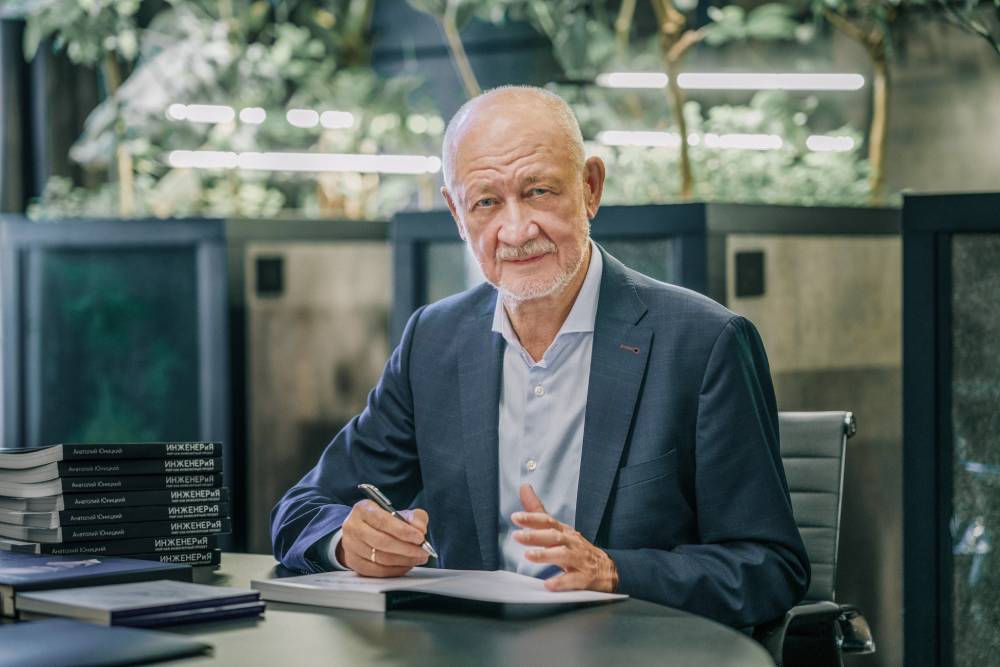
In a new in-depth interview, Anatoli Unitsky, General Designer of UST Inc., discusses his engineering journey, the development of string transport technology, and the principles that have guided his work.
In a conversation with the newspaper’s Editor-in-Chief, Anatoli Unitsky reflects on the key stages in the development of uST technology — from the first experimental tracks to commercial implementation — as well as the creation of the Unitsky Engineering Academy, which is working on an innovative transport system.
The interview also focuses on the future of string transport. The General Designer of UST Inc. outlines plans for the high-speed Minsk–Moscow connection, the development of transport corridors, and the transition to scaling up the technology.
At the same time, the conversation goes far beyond engineering. Anatoli Unitsky shares the principles that have shaped his life and reveals the secret that has helped him remain committed to his chosen path for decades.
“If an engineer can improve millions of people’s lives, he should try,” Anatoli Unitsky emphasized.
Read the full interview.
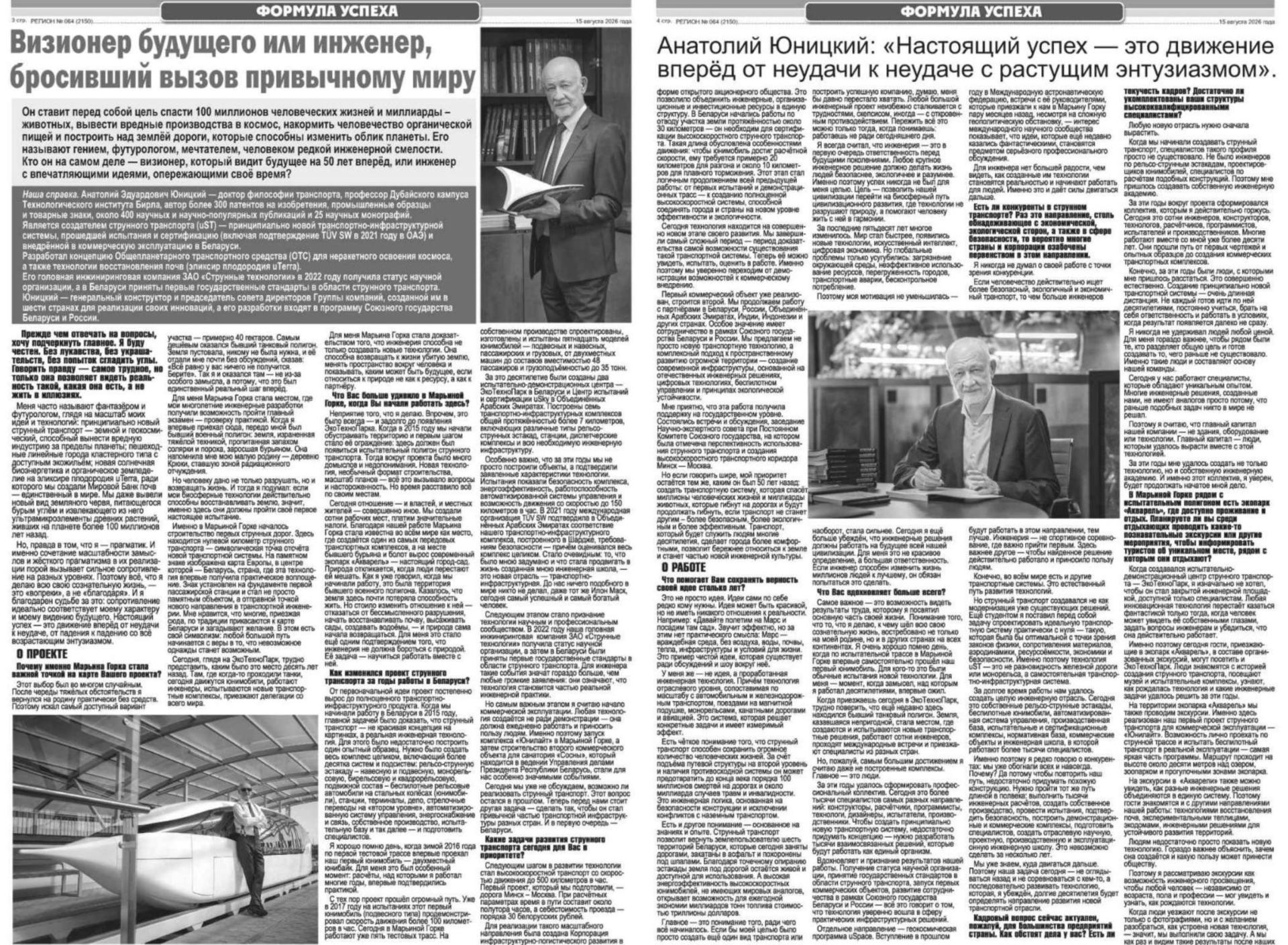
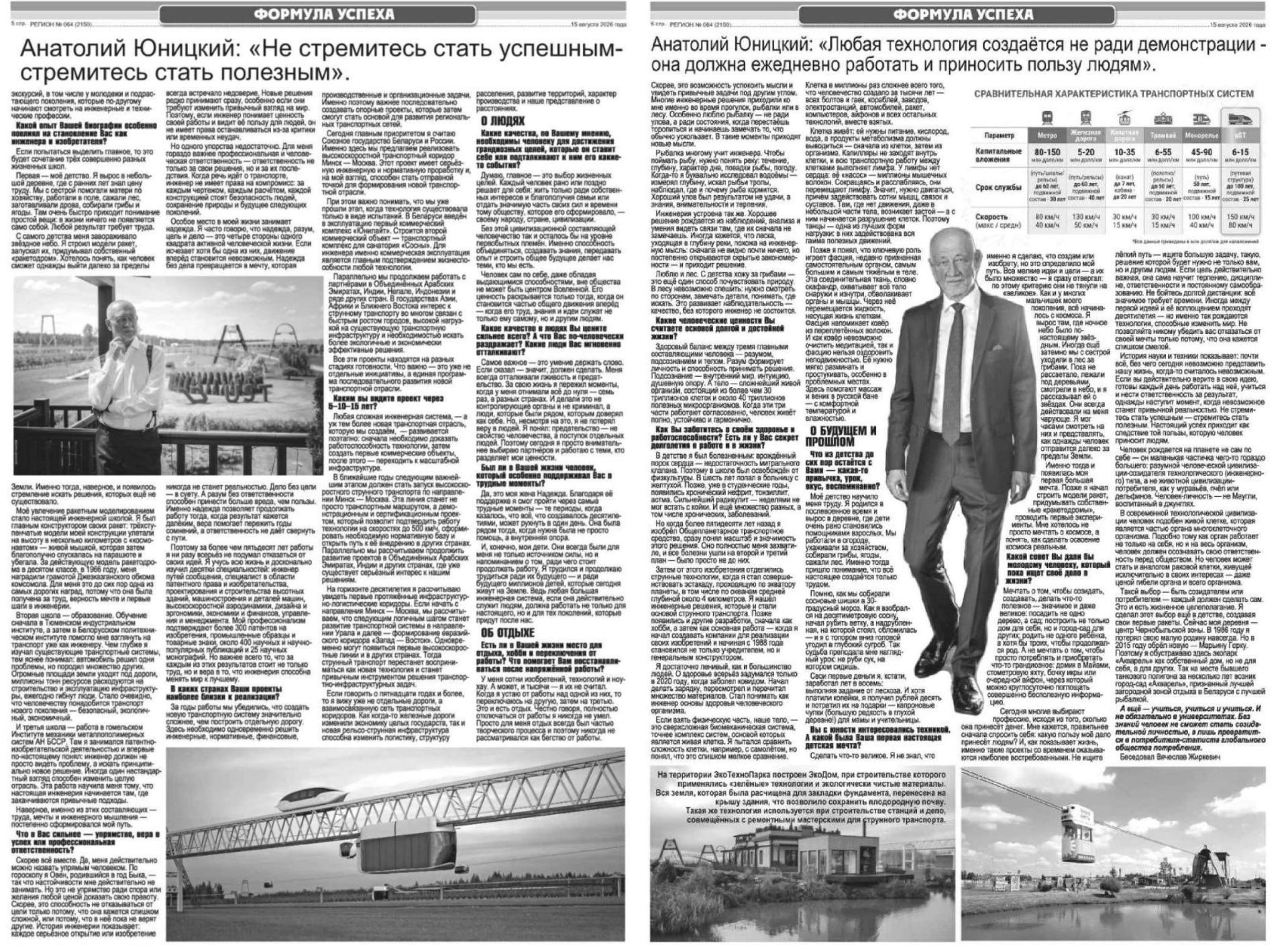
VISIONARY OF THE FUTURE OR AN ENGINEER CHALLENGING THE STATUS QUO
He has set himself the goal of saving 100 million human lives and billions of animals, moving harmful industries into space, feeding humanity organic food, and building elevated roads that could transform the way we live on the planet. He has been called a genius, a futurist, a dreamer, and a man of rare engineering courage. But who is he really—a visionary who can see 50 years into the future, or an engineer whose ideas are simply ahead of their time?
Profile: Anatoli Unitsky holds a PhD in Transport and is an Adjunct Professor in the Department of Chemical Engineering at BITS Pilani, Dubai Campus. He is the author of more than 300 patents covering inventions, industrial designs, and trademarks, as well as around 400 scientific and popular science publications and 25 scientific monographs. He is the creator of string transport (uST), a fundamentally new transportation and infrastructure system that has undergone testing and certification, including certification by TÜV SW in the UAE in 2021, and has been put into commercial operation in Belarus. He also developed the concept of the General Planetary Vehicle (GPV) for the non-rocket exploration of space, as well as soil restoration technologies, including the uTerra fertility elixir.
His flagship engineering company, Unitsky String Technologies Inc., was granted scientific-organization status in 2022, and Belarus subsequently adopted its first national standards for string transport. Unitsky is the Chief Designer and Chairman of the Board of Directors of a group of companies he established across six countries to develop and implement his innovations. His technologies are also included in joint programs of the Union State of Belarus and Russia.
Before I answer your questions, I want to make one thing clear above all: I will be honest. No beating around the bush, no embellishment, and no attempt to smooth the edges. Telling the truth is one of the hardest things to do, but it is the only way to see reality as it is rather than live in an illusion.
People often call me a dreamer or a futurist when they look at the scale of my ideas and technologies: a fundamentally new form of string transport—both terrestrial and geocosmic—that could move harmful industries beyond the planet; pedestrian linear cities built around clusters, with affordable eco-friendly housing; a new form of solar bioenergy and organic farming based on the uTerra fertility elixir. It was for this purpose that we created the World Soil Bank, which is unique in the world. We even developed a new species of earthworm that feeds on lignite coal and extracts ultra-trace elements from it—elements originating from ancient plants that lived on Earth more than 100 million years ago.
But the truth is, I’m a pragmatist. And it’s precisely that combination—the sheer scale of my ambitions and the hard pragmatism I bring to making them happen—that sometimes meets with strong resistance at different levels. So, everything I’ve done throughout my life has always been “in spite of”, not “thanks to.”. And I’m grateful to fate for that. Resistance suits my character and my vision of the future. To me, true success means continuing to move forward despite failure and setbacks, with even greater enthusiasm each time.
ABOUT THE PROJECT
Why did Maryina Horka become such an important point on the map for your project?
The choice was largely a matter of chance. After a series of difficult circumstances, I returned to my homeland with practically nothing. I was looking for the most affordable piece of land I could find—about 40 hectares. The cheapest option turned out to be a former tank training ground. The land was sitting unused, nobody wanted it, and they practically handed it over to me, saying, “You won’t get anywhere with this anyway. Take it.” And that’s how I ended up there—not because I had some special plan for the place, but because it was the only realistic step forward.
For me, Maryina Horka became the place where decades of engineering work could finally face its biggest test: the test of real-world application. When I first arrived, all I saw was a former military training ground: land torn up by heavy machinery, soaked with the smell of diesel fuel and gunpowder, and overgrown with weeds. It reminded me of my native village, Kryuki, which later became part of the radioactive exclusion zone.
But people are capable of more than just destruction. We can also bring life back. And I thought: if my biosphere technologies really can restore damaged land, then this is exactly where they should face their first real test.
It was here in Maryina Horka that construction began on the first string roads. This is where the zero kilometer of string transport is located—the symbolic starting point of a new transportation system. The memorial marker features a map of Europe, with Belarus at its center—the country where this technology was first put into practice. It stands on the foundation of the first passenger station and has become more than just a memorial. It marks the beginning of a new direction in transportation engineering. I like the fact that many people who come here instinctively touch the map of Belarus and make a wish. There’s something symbolic about that: every great journey begins with believing that what seems impossible can one day become possible.
Today, when you look at the EcoTechnoPark, it’s hard to imagine what this place looked like ten years ago. Where tanks once drove across the land, now you see uPods moving along the tracks, engineers at work, new transportation systems being tested, and delegations arriving from all over the world.
For me, Maryina Horka has become proof that engineering can do more than create new technologies. It can bring devastated land back to life, reshape the environment around us, and show us what the future could look like if we stop treating nature simply as a resource and start treating it as a partner.
What surprised you most about Maryina Horka when you first started working here?
The resistance to what I was doing. Although, that had always been the case, long before the EcoTechnoPark even existed. When we started developing the site in 2015, our first step was to fence it off: here was going to be a testing ground for string transport. At the time, there was a lot of speculation and misunderstanding surrounding the project. A new technology, an unusual approach to construction, the scale of our plans—all of that raised questions and made people wary. But over time, things changed.
Today, the attitude of both the authorities and local residents is completely different. We’ve created hundreds of jobs and pay substantial amounts in taxes. Thanks to our work, Maryina Horka has become known around the world as a place where one of the most advanced transportation complexes is being developed. And where weeds and swamps once covered the land, we’ve built the modern “Aquarelle” EcoPark—a true garden city. Nature responds when people stop getting its way. As I said earlier, when we started working here, this was a former military training ground. It seemed as though the land had almost lost its ability to support life. But once we changed our approach—stopped destroying it for no reason, began restoring the soil, planting orchards, and creating ponds—nature itself started to come back. For me, that became yet another confirmation that engineering shouldn’t be about fighting nature. Its job is to learn how to work with it.
How has the string transport project evolved over the years you’ve been working in Belarus?
The project has grown from an initial idea into a full-fledged transportation and infrastructure system. When we started working in Belarus in 2015, our main task was to prove that string transport was not just an attractive concept on paper, but a real engineering technology.
But building a single prototype wasn’t enough. We had to build the entire system from the ground up, with more than a dozen interconnected systems and subsystems: string rail overpasses, both mounted and suspended configurations, monorail, dual-rail and quad-rail systems; rolling stock—unmanned rail vehicles on steel wheels, or uPods; stations, terminals, depots, second-level switches, an automated control system, power supply and communications, our own manufacturing facilities, testing infrastructure, and much more. We also had to train the specialists needed to make it all work.
I remember that winter day in 2016 when our very first uPod—a two-seat uBike—made its first run on the initial test track. It was a special moment for me: the calculations I had worked on for years were finally being put to the test in the real world.
We’ve come a long way since then. By 2017, during testing, that first suspended uPod had already reached speeds of more than 100 kilometers per hour. Today, there are five test tracks operating in Maryina Horka. At our own manufacturing facility, we have designed, built, and tested 15 uPod models—suspended and mounted, for passengers and cargo, ranging from two-seat vehicles to trains capable of carrying 48 passengers and up to 35 tons of cargo.
Over the past decade, we have established two testing and demonstration centers—the EcoTechnoPark in Belarus and the uSky Testing and Certification Center in the United Arab Emirates. We have also built seven transportation and infrastructure complexes with a combined length of more than seven kilometers. They include different types of string rail overpasses, stations, control centers, and all the necessary engineering infrastructure.
What matters most is that we haven’t simply built facilities—we’ve demonstrated that the technology can deliver what we said it could. Testing has confirmed the system’s safety, energy efficiency, the reliability of its automated control system, and its ability to operate at speeds of up to 150 kilometers per hour. In 2021, the international organization TÜV SW confirmed in the United Arab Emirates that our transportation and infrastructure complex in Sharjah met safety requirements. Importantly, the assessment covered the entire complex, not just individual components. It became clear that what I had envisioned—and what the engineering school I built had worked to bring into reality—was an entirely new transportation and infrastructure industry. Nothing like this had been done anywhere in the world before—not even by Elon Musk, who is now one of the world’s most successful and wealthiest entrepreneurs.
The next step was recognition of the technology by the scientific and professional communities. In 2022, our main engineering company, Unitsky String Technologies Inc., was granted the status of a scientific organization. Belarus then adopted its first national standards for string transport. For an engineer, milestones like these mean far more than any high-profile statements. They mean the technology is becoming part of real-world engineering practice.
But to me, the most important milestone has been the start of commercial operations. Technology isn’t created simply to be demonstrated—it has to work every day and deliver real benefits to people. That’s why the launch of the uLite complex in Maryina Horka, followed by the construction of a second commercial facility for the Sosny sanatorium, which is managed by the Property Management Directorate of the President of the Republic of Belarus, was especially significant for us.
Today, we’re no longer debating whether string transport can actually work in practice. That question is behind us. The challenge now is to make it a familiar part of transportation infrastructure around the world – starting with Belarus.
What are your priorities for the development of string transport today?
The next step is high-speed transport capable of reaching speeds of up to 500 kilometers per hour. The first project we’ve developed is the Minsk–Moscow line. At the projected speeds, the journey would take about an hour and a half, with a fare of around 30 Belarusian rubles.
To move such a large-scale project forward, we established the Infrastructure and Logistics Development Corporation as an open joint-stock company. That gave us a way to bring our engineering, organizational, and investment resources together under one roof. In Belarus, we’ve begun the process of securing a roughly 30-kilometer stretch of land needed to certify the high-speed system. The length is dictated by how the system works: a uPod needs about 20 kilometers to reach its design speed and another 10 kilometers to slow down smoothly. This is the natural next step in everything we’ve done—from the first tests and demonstration tracks to a full-scale high-speed system capable of connecting cities and countries more efficiently and sustainably.
Today, the technology has entered a completely new stage. We’ve made it through the hardest part: proving that this kind of transportation system can actually work. Now people can see it, test it, and evaluate it in operation. That’s why we are confidently moving from demonstrating what the technology can do to putting it into commercial operation.
The first commercial facility is already up and running, and a second one is under construction. We continue to work with partners in Belarus, Russia, the United Arab Emirates, India, Indonesia, and other countries. Our work within the Union State of Belarus and Russia is particularly important to us. We’re offering more than just a new transportation technology. We’re proposing a broader approach to developing a vast territory—modern infrastructure built around our own engineering solutions, digital technologies, autonomous control, and environmental sustainability.
I’m pleased that this work has received support at the national level. We’ve held meetings and discussions, including a session of the Scientific and Expert Council under the Permanent Committee of the Union State, where the potential of string transport and the creation of a high-speed Minsk–Moscow transportation corridor were recognized.
But if we look at the bigger picture, my priority remains the same as it was 50 years ago: to create a transportation system that will save millions of human lives and billions of animals that die on the roads, and will continue to die unless we change the way we move. It has to become safer, more environmentally friendly, and more efficient. A transportation system can serve people for decades, make cities more livable, use land more responsibly, and become part of a new engineering culture.
ABOUT THE WORK
What has helped you stay committed to your idea for so many years?
It’s not just an idea. An idea on its own is rarely enough. An idea can sound great and still have little to do with reality. For example: “Let’s fly to Mars and plant a garden there.” It sounds impressive, but there’s no practical substance behind it. Mars is a hostile environment—with no air, water, soil, warmth, infrastructure, or conditions for life. That’s a pure idea—something that exists mainly to be talked about and put on a show.
What I have is not just an idea, but a fully developed engineering technology. And not just any technology—it’s an industry-scale system, comparable in scope to automobiles, railways, maglev trains, monorails, cable cars, and aviation. It’s designed to solve specific problems and deliver measurable results.
We know that string transport can save an enormous number of human lives. By elevating the track structure to a second level and using an anti-derailment system, it could prevent roughly 100 million road deaths and around one billion injuries and cases of disability by the end of the century. That’s straightforward engineering: make the system safer by separating it from ground-level traffic.
There’s another benefit as well—one grounded in what we’ve learned through experience. String transport could return to land users six areas of Belarus that are now taken up by roads, covered in asphalt, or occupied by railway tracks. Because the overpass rests on individual supports, the land underneath remains usable and accessible. And the high energy efficiency of our high-speed uPods, which have no equivalent anywhere else in the world, could translate into annual savings of billions of tons of fuel—worth trillions of dollars.
The most important thing is understanding why it all started in the first place. If my goal had simply been to create another form of transportation or build a successful company, I don’t think that would have been enough to keep me going for this long. Any major engineering project inevitably runs into difficulties, skepticism, and sometimes outright opposition. You can get through all of that only if you know you’re working for something bigger than today.
I have always believed that engineering is, first and foremost, a responsibility to future generations. Any major engineering decision should make people’s lives safer, more sustainable, and more rational. That’s why success has never been the goal for me. The goal is to help our civilization move toward a biosphere-based path of development—one where technology doesn’t destroy nature, but helps us live in harmony with it.
A lot has changed in the past 50 years. The world has become faster, and we’ve seen the emergence of new technologies, artificial intelligence, and the digital economy. But many of the world’s biggest problems have only gotten worse: environmental pollution, inefficient use of resources, overcrowded cities, transportation accidents, and uncontrolled consumption.
So my motivation hasn’t diminished. If anything, it’s stronger than ever. Today, I’m more convinced than ever that engineering has to serve the future of our civilization. For me, that’s not just a nice-sounding idea. It’s a responsibility. If an engineer can improve millions of people’s lives, he should try.
What inspires you most today?
What inspires me most is seeing the results of the work I’ve devoted most of my life to. Knowing that what I’ve spent my entire life working toward is needed not only in my homeland, but in countries around the world. I still remember the day our first uPod made its first fully autonomous run on the test track in Maryina Horka. For some people, it was just a routine test of a new technology. For me, it was the moment an idea I’d been working on for decades finally came to life.
When you visit the EcoTechnoPark today, it’s hard to believe this place was once a tank training ground. Land that once seemed unusable is now a place where new transportation technologies are developed and tested, hundreds of engineers work, international meetings take place, and specialists from around the world come to visit.
But perhaps my greatest achievement isn’t the facilities we’ve built at all. It’s the people.
Over the years, we’ve built a team of professionals I’m genuinely proud of. Today, it includes more than a thousand specialists from a wide range of fields: designers, engineers, programmers, process engineers, industrial designers, test engineers, and manufacturing specialists. To create a fundamentally new transportation system, coming up with the concept is only the beginning. You have to develop thousands of interconnected solutions that work together as one system.
It’s also inspiring to see our work gaining recognition. Being granted scientific-organization status, seeing Belarus adopt national standards for string transport, launching our first commercial facilities, and expanding our cooperation within the Union State of Belarus and Russia—all of this shows that the technology is becoming part of real-world infrastructure.
Another area that inspires me is the uSpace geocosmic program. Joining the International Astronautical Federation last year, and then meeting with its leadership when they visited us in Maryina Horka a couple of months ago despite the difficult geopolitical situation, was especially meaningful. It shows that ideas that once seemed like science fiction are now being taken seriously by the international scientific community.
For an engineer, there’s no greater satisfaction than seeing technologies you created become reality and start working for people. That’s what gives me the strength to keep going.
Are there any competitors in string transport? Given the economic, environmental, and safety potential of this field, I assume many countries and corporations are interested in taking the lead.
I’ve never viewed my work as a competition.
If humanity is truly looking for transportation that is safer, cleaner, and more economical, then the more engineers working toward that goal, the better. Engineering isn’t a race to see who gets there first. What matters is finding a solution that actually works and benefits people.
Of course, there are other transportation systems being developed around the world. That’s a natural part of technological progress.
But string transport wasn’t designed as an upgrade to an existing system. When I was still a student, I set out to design an ideal transportation system from scratch—one optimized for the laws of physics, material strength, aerodynamics, resource use, economics, and safety. That’s why uST is not simply another type of railway or monorail. It is an independent transportation and infrastructure system.
Over the years, we’ve built an entire engineering field around it. Today, that includes our own string rail overpasses, unmanned uPods, an automated control system, manufacturing facilities, testing and certification complexes, a regulatory framework, commercial facilities, and an engineering school with more than a thousand specialists.
That’s why I rarely talk about competitors. We’ve already built a substantial lead, and that lead isn’t something that can be closed overnight. Why? Because coming up with a similar design is only the beginning. You would have to go through the same half-century journey: carry out thousands of engineering calculations, build your own manufacturing facilities, conduct testing, demonstrate safety, build demonstration and commercial complexes, train specialists, and build an entire engineering ecosystem spanning research, design, manufacturing, and operations. You can’t build all of that in a few years.
We already know where we’re going next. So today, our task isn’t to look back or compete with anyone. It’s to keep developing a technology that, I’m convinced, will shape this new transportation industry for decades to come.
The shortage of qualified personnel is a pressing issue for most companies in the country today. How are things on your side? Are you experiencing employee turnover? Do you have enough highly qualified specialists to fully staff the company?
Any new industry has to be built from the ground up.
When we started developing string transport, specialists in this field simply didn’t exist. There were no engineers specializing in string rail overpasses, no uPod designers, and no experts with experience calculating structures like these. So I had to build our own engineering academy.
Over the years, we’ve built a team around this project that I’m proud of. Today, it includes hundreds of engineers, designers, process engineers, analysts, programmers, testing specialists, and manufacturing professionals. Many of them have been working with me for more than ten years. They’ve been with us from the very first drawings and prototypes through to the development of commercial transportation complexes.
Of course, over the years there have also been people I’ve had to part ways with. That’s perfectly natural. Creating a fundamentally new transportation system is a long journey. Not everyone is willing to stay on that path for decades—to keep learning, take responsibility, and work when the results may not show up right away.
I’ve never tried to hold on to people at any cost. What matters much more to me is having people around me who share the same goal and are willing to create something that has never existed before. Those are the people who make up the backbone of our team.
Today, we have specialists with truly unique experience. Many of the engineering solutions we’ve developed have no equivalent simply because no one had tackled these problems before.
That’s why I believe our greatest asset isn’t our buildings, equipment, or technology. It’s the people who have grown alongside it.
Over the years, I’ve built not only the technology itself, but also our own engineering academy. And I’m confident that this team will carry that work forward.
There is an “Aquarelle” EcoPark next to the testing site in Maryina Horka, where visitors can stay and spend some time. Do you plan to offer educational tours or other activities for guests, so they can learn more about this unique place right next door?
When we created the EcoTechnoPark—the testing and demonstration center for string transport—I never wanted it to become a closed engineering facility accessible only to specialists. Any innovative technology stops seeming like science fiction when people can see it with their own eyes, talk to the engineers, and see that it actually works.
That’s why guests staying at the “Aquarelle” EcoPark can now visit the EcoTechnoPark as part of an organized tour. They can learn about the history of string transport, visit the museum and testing facilities, and see how the technology evolved and what engineering challenges we had to overcome along the way.
We also offer tours at “Aquarelle” EcoPark itself. This is where our first string transport project for commercial operation—the uLite—was launched. The highlight of the program is being able to ride along the string track and experience unmanned transportation in real-world operation. The route runs about ten meters above the lake, the zoo, and the park’s recreational areas.
During the “Aquarelle” tours, visitors can also see how different engineering solutions come together as part of a single system. It also gives them a chance to learn about other areas of our work, including soil restoration technologies, experimental greenhouses, eco-homes, and engineering solutions for sustainable territorial development.
It’s not enough simply to show people a new technology. What matters is explaining why it was created and what it can do for society.
That’s why I see these tours as a form of engineering education—so that anyone, regardless of age, gender, or profession, can see and learn how technologies are created.
When people leave with more than just photographs—with a genuine desire to understand how the technology works—we know we’ve accomplished what we set out to do. And that’s exactly what we’re seeing, especially among young people. They begin to look at engineering and technical careers in a completely different way.
What experiences in your life had the greatest influence on you as an engineer and inventor?
If I had to single out the most important influences, I’d say they came from three very different schools of life.
The first was my childhood. I grew up in a small village, where from an early age I learned the value of hard work. My sister and I helped our mother with the household, worked in the fields, planted trees, gathered firewood, picked mushrooms and berries. You learn a simple lesson very quickly in that kind of environment: nothing in life comes to you on its own. Everything worthwhile takes work.
From an early age, I was fascinated by the night sky. I built model rockets, launched them, and even created my own little “spaceport.” I wanted to understand how, one day, human beings might venture far beyond Earth. That was probably when I first developed the drive to look for solutions that didn’t exist yet.
My passion for rocketry became an education in engineering. I was the chief designer of my own rockets. My three-stage models reached altitudes of several kilometers carrying a “cosmonaut”—a live mouse that would parachute safely back to Earth and run off. In 1966, when I was in tenth grade, I received a certificate of recognition from the Dzhezkazgan Regional Committee of the Komsomol for my working model of a launch site. To this day, it remains one of the awards I value most because it recognized hard work, staying true to a dream, and my first steps in engineering.
The second school was education. Studying first at the Tyumen Industrial Institute and later at the Belarusian Polytechnic Institute taught me to look at transportation as an engineer. The more deeply I studied existing transportation systems, the clearer it became that the automobile had solved some problems but created many others. Enormous amounts of land were being taken up by roads, millions of tons of resources were being consumed to build and maintain infrastructure, and people were dying every year. It became clear that humanity would need a new generation of transportation—safer, cleaner, and more economical.
The third school was my work at the Institute of Mechanics of Metal-Polymer Systems of the Academy of Sciences of the Byelorussian SSR in Gomel. There, I worked in patents and invention, and for the first time I truly understood that an engineer has to do more than identify a problem—he has to look for a fundamentally new solution. Sometimes, one unconventional way of looking at a problem can transform an entire industry. That work taught me that true engineering begins where conventional approaches end.
I suppose my path gradually took shape from those three things: hard work, a dream, and an engineering mindset.
What’s stronger in you—stubbornness, faith in success, or professional responsibility?
Probably all three together.
Yes, you could certainly call me stubborn. I’m an Aries born in the Year of the Ox, according to the Chinese zodiac, so persistence is definitely not something I lack. But it’s not about being stubborn for the sake of arguing or proving I’m right at any cost. It’s more about staying committed to a goal simply because it’s difficult, or because other people don’t believe in it yet. The history of engineering shows that every major discovery or invention has faced skepticism. New solutions are rarely accepted right away, especially when they require people to change the way they look at the world. So if an engineer understands the value of his work and sees how it can benefit people, he can’t afford to stop because of criticism or temporary setbacks.
But persistence alone isn’t enough. To me, professional and human responsibility matter far more—the responsibility not only for your decisions, but also for their consequences. When it comes to transportation, an engineer can’t afford to compromise. Behind every drawing, every calculation, and every structure are people’s safety, the preservation of nature, and the future of generations to come.
Hope also holds a special place in my life. I often say that hope, reason, purpose, and action are the four sides of the same square—the foundation of an active human life. If even one of them is missing, moving forward becomes impossible. Hope without action becomes a dream that never turns into reality. Action without purpose becomes aimless activity. And reason without responsibility can do more harm than good. Hope keeps you working when the result still seems far away, faith helps you get through years of doubt, and responsibility keeps you from losing your way.
That’s why, in more than 50 years of work, I’ve never seriously considered giving up on my ideas. I’ve been learning my entire life, and I’ve studied dozens of fields in depth: transportation engineering, patent law and invention, the design and construction of high-rise buildings, mechanical engineering and machine components, high-speed aerodynamics, design and ergonomics, economics and finance, administration and management. My professional background is reflected in more than 300 patents covering inventions, industrial designs, and trademarks, around 400 scientific and popular science publications, and 25 scientific monographs. But what matters most is that behind each of those achievements is not only hard work, but also the belief that engineering can change the world for the better.
In which countries are your projects closest to becoming a reality?
Over the years, we’ve learned that creating an entirely new transportation system is far more complicated than building a single road. You have to tackle engineering, regulatory, financial, manufacturing, and organizational challenges all at once. That’s why it’s more important to build anchor projects that can eventually serve as the foundation for regional transportation networks.
Today, my top priority is the Union State of Belarus and Russia. This is where we are proposing to develop the Minsk–Moscow high-speed transportation corridor. The project has already undergone substantial engineering and regulatory work and, in my view, could become the starting point for an entirely new transportation industry.
At the same time, it’s important to understand that we’ve moved beyond the stage when the technology existed only in testing. Belarus has already put the first commercial uLite complex into operation. A second commercial facility—a transportation complex for the Sosny sanatorium—is now under construction. For an engineer, commercial operation is the ultimate proof that a technology actually works.
We also continue to work with partners in the United Arab Emirates, India, Nepal, Indonesia, and a number of other countries. In Asia, Africa, and the Middle East, much of the interest in string transport comes from rapid urban growth, pressure on existing transportation infrastructure, and the need for more sustainable and cost-effective solutions.
These projects are all at different stages of development. What matters is that they are no longer isolated initiatives. They’re part of a broader, step-by-step effort to build an entirely new transportation industry.
How do you see the project evolving over the next 5, 10, or 15 years?
Any complex engineering system—and especially a new transportation industry like the one we’re building—has to evolve in stages. First, you have to prove that the technology works. Then you build the first commercial facilities. After that, you can move on to large-scale infrastructure.
Over the next few years, the next major milestone should be launching high-speed string transport on the Minsk–Moscow route. This line will be more than just a transportation route. It will serve as a demonstration and certification project, allowing us to validate the technology at speeds of up to 500 kilometers per hour, establish the necessary regulatory framework, and pave the way for its adoption elsewhere. We also expect to keep developing projects in the United Arab Emirates, India, and other countries where there is already strong interest in our solutions.
Over the next decade, I expect to see the first long-distance infrastructure and logistics corridors take shape. If we start with the Minsk–Moscow route, the next logical step would be to extend the system toward the Urals and, from there, develop a Eurasian West–East corridor. At the same time, the first high-speed lines could emerge in other countries as well. At that point, string transport will no longer be seen as a new technology. It will become a familiar tool for solving transportation and infrastructure challenges.
Looking 15 years ahead and beyond, I no longer see individual roads. I see an interconnected network of transportation corridors. Just as railways once transformed the economies of entire countries, a new string rail infrastructure could transform logistics, settlement patterns, regional development, the way goods are produced, and even our sense of distance.
ABOUT PEOPLE
What qualities do you think a person needs to achieve the ambitious goals they set for themselves or that circumstances push them toward?
I think the most important thing is choosing your goals in life. Sooner or later, everyone has to decide: do I want to live primarily for myself and my family, or am I willing to devote a meaningful part of my time and energy to the society that shaped me—to my people, my country, and civilization as a whole?
Without that broader civilizational dimension, humanity would still be living as primitive tribes. Our ability to come together, create knowledge, pass experience from one generation to the next, and build a shared future is what has made us who we are.
A person, no matter how exceptional their abilities may be, cannot be the center of the universe outside society. Their true value emerges when they become part of a broader movement forward—when their work, knowledge, and ideas serve not only themselves, but other people as well.
What quality do you value most in people? And what gets under your skin on a human level? What kind of people immediately put you off?
The most important thing is keeping your word. If you give your word, you have to follow through. I’ve always been put off by dishonesty and betrayal. Seven times in my life, in different countries, I went through situations where everything was taken away from me, leaving me with nothing. And it wasn’t the authorities or criminals who did it. It was people who were close to me—people I trusted as much as I trusted myself. But despite all of that, I never lost faith in people. I came to understand that betrayal isn’t a trait of humanity as a whole. It’s a choice individual people make. So today, I’m simply more careful about choosing my partners and work with people who share my values.
Was there someone in your life who was especially supportive of you during difficult times?
Yes – my wife, Nadezhda. Her support helped me get through some of the most difficult periods of my life – those moments when it seemed that everything I had spent decades building could collapse in a single day. She was there when what I needed wasn’t simply help, but someone to lean on—someone who could give me the inner strength to keep going.
And, of course, my children. They have always been not only a source of strength, but also a reminder of why the work is worth continuing. I have worked, and continue to work, for their future and for the future of the millions of children living on Earth today. Because any major engineering system, if it is truly designed to serve people, should serve more than just those living today. It should also serve the generations that come after us.
ABOUT REST AND LEISURE
Is there room in your life for rest, hobbies, and time away from work? What helps you recharge after demanding work?
I have hundreds of inventions, technologies, and pieces of know-how. Maybe even thousands, I’ve never counted them. When I get tired of working on one of them, I switch to another, and then to a third. That’s my way of resting. To be honest, I’ve never been good at completely switching off from work. For me, rest has always been part of the creative process, so I’ve never seen it as an escape from work. If anything, it gives me a chance to clear my mind and look at familiar problems from a different angle. Many of my engineering ideas have come to me while walking, fishing, or spending time in the woods. I especially enjoy fishing – not for the catch, but for that state of mind when you stop rushing and start noticing things that would normally pass you by. That’s when new ideas come to me.
Fishing teaches an engineer a lot. To catch a fish, you have to understand the river: the current, the depth, the nature of the riverbed, the fish’s habits, the weather. At one point, I literally studied bodies of water: measuring their depth, looking for fish paths, and observing where and why the fish were feeding. A good catch wasn’t a matter of luck. It was the result of knowledge, attentiveness, and patience.
Engineering works much the same way. A good solution comes from observation, analysis, and the ability to see connections that you don’t notice at first. Sometimes I think a fishing line disappearing into the depths of a river is a lot like an engineering idea: at first, you can hardly see anything, but little by little, hidden patterns emerge, and then the solution comes.
I love the woods, too. I’ve been picking mushrooms since I was a child. It’s another way for me to connect with nature. You can’t rush in the woods. You have to look around, notice the details, and understand where to look. It develops the kind of observational skills an engineer simply can’t do without.
What human values do you consider essential to living a long and fulfilling life?
A healthy balance between the three main parts of a human being – the mind, the subconscious, and the body. The mind shapes our personality and our ability to make decisions. The subconscious is our inner world, our intuition, and our emotional foundation. And the body is an incredibly complex living organism made up of more than 30 trillion cells and around 40 trillion beneficial microorganisms. When these three parts works in harmony, a person can live a full, stable, and balanced life.
How do you take care of your health and maintain your ability to keep working? Do you have a secret to longevity, both in your work and in life?
As a child, I was sickly. I was born with a heart defect – mitral valve insufficiency. So I was excused from physical education at school. When I was six, I was hospitalized with jaundice. Later, during my student years, I developed chronic nephritis, tonsillitis, and asthma. I also suffered from severe sciatica and sometimes couldn’t get out of bed for weeks. And there were many other conditions, including chronic ones.
But more than 50 years ago, when I invented the General Planetary Vehicle, I immediately understood the scale and importance of what I had done. It completely consumed me, and all those illnesses took a back seat. I simply didn’t have time to think about them.
Later, string technologies grew out of that invention as I began refining an overpass that would run around the planet along the equator, including across oceans with an average depth of about four kilometers. I found engineering solutions that eventually became the foundation of string transport. Other projects followed, first as hobbies and later as my main work, when I began creating companies to bring my inventions to life. Starting in 1988, I became not only a founder, but also a chief designer.
I’m actually pretty lazy, like most people. I only started taking my health seriously in 2020, when I got COVID. I started exercising, read and reread a huge amount of material, and began to understand the fundamentals of human health from an engineer’s perspective.
If you look at the physical side of it, the human body is an extraordinarily complex biomechanical system—or, more precisely, a complex of systems whose basic unit is the living cell. I tried comparing the complexity of a cell to that of an airplane, for example, but realized that was far too simplistic. A cell is millions of times more complex than everything humanity has created over thousands of years – all the bolts and nuts, ships, factories, power plants, cars, rockets, computers, iPhones, and every other technology combined.
A cell is alive. It needs nutrients, oxygen, and water, and metabolic waste has to be removed – first from the cell and then from the body. Capillaries don’t extend inside the cell, so the lymphatic system handles the transport between cells. The lymphatic system has no heart. Its “pump” is millions of muscle fibers. As they contract and relax, they move lymph through the body. That means we need to move—and not just a little, but enough to engage hundreds of muscles, ligaments, and joints. Where there is no movement, even in a small part of the body, stagnation sets in—and that’s where cell breakdown begins. That’s why dancing is one of the best forms of exercise: it engages the full range of beneficial movement.
Later, I came to understand that fascia plays a key role. It has recently been recognized as an organ in its own right and is the largest and heaviest organ in the body. This connective tissue is like a spacesuit wrapped around the entire body, both inside and out, surrounding the organs and muscles. Fluid carrying what cells need to survive moves through it. Fascia resembles a carpet made of interwoven fibers. And just as you can’t clean a carpet through meditation, you can’t improve the health of fascia by remaining still. It needs to be gently worked and tapped, especially in problem areas. Massage and a venik—a traditional bundle of leafy branches used in a Russian sauna—can help, provided the temperature and humidity are comfortable.
ABOUT THE FUTURE AND THE PAST
What from your childhood has stayed with you to this day – a habit, a lesson, a taste, a memory?
My childhood taught me the value of hard work. I was born in the postwar period and grew up in a village where children became helpers to adults at a very young age. We worked in the garden, took care of the household, picked mushrooms and berries, and planted trees. That’s where I learned that anything worthwhile takes hard work.
I remember gathering pinecones in temperatures 30 degrees below zero. Once, I climbed a ten-meter pine tree and started chopping at a branch. The branch I was standing on suddenly snapped, and I went headfirst into a deep snowdrift, axe and all. That was fate giving me a very practical lesson: don’t cut off the branch you’re sitting on.
I actually earned my first money when I was about eight, doing a job for the local forestry service. It wasn’t much, but I made about ten rubles and spent it on gifts—nylon stockings for my mother and my teacher. Nylon stockings were a big deal in a remote village back then!
You’ve been interested in technology since you were young. What was your first real childhood dream?
To do something great. I didn’t know exactly what I would create or invent, but that ambition set the course for my life. I dismissed all the small ideas and goals—and there were plenty of them—because, by my own standard, they simply didn’t qualify as “great.” Like many boys of my generation, it all started with space. I grew up in a place where the night sky was truly filled with stars. Sometimes, before dawn, my sister and I would head into the woods to pick mushrooms. While we waited for daylight, we would lie under the trees, look up at the sky, and I would tell her about the stars. They always fascinated me. I could stare at them for hours, imagining that one day human beings would travel far beyond Earth.
That was when my first big dream took shape. Later, I began building model rockets, designing my own “spaceports,” and running my first experiments. I didn’t want to simply dream about space. I wanted to understand how to make space exploration a reality.
What advice would you give a young person who is still trying to find their calling in life?
Dream about creating things. About doing something useful – something meaningful, even something great. Plant not just one tree, but a garden. Build not just a house for yourself, but a garden city for others. Have not just one child, but at least three, so the family line continues. Don’t dream simply of consuming and acquiring something extravagant – a house in Miami, a 100-meter yacht, a barrel of caviar, or the latest iPhone that lets you spend all day consuming completely useless information.
Today, many people choose a career based on how much money it will make them. I think it’s better to ask yourself first: what good will my work do for other people. And as life shows, those are often the projects that end up being the most needed. Don’t look for the easy path. Look for a big challenge—a problem whose solution will matter not only to you, but to other people as well. If the goal is truly important, it will teach you patience, discipline, responsibility, and the need to keep learning. Don’t be afraid of the long haul. Anything meaningful takes time. Sometimes decades pass between the first idea and its realization—but that’s how technologies capable of changing the world are born. Don’t let anyone convince you to give up on your dream simply because it seems too ambitious.
The history of science and technology shows that almost everything we can’t imagine life without today was once considered impossible. If you truly believe in your idea, are willing to work on it every day, keep learning, and take responsibility for the result, eventually the day will come when the impossible becomes part of everyday reality. Don’t strive to be successful—strive to be useful. True success is a result of the value a person brings to others.
A person is not born onto this planet in isolation. They are a small part of something much larger: a conscious human civilization—a civilization of creators built on technology and engineering, rather than a civilization of consumers like ants, bees, or dolphins. An individual is not Mowgli, raised in the jungle.
In a modern technological civilization, a person is like a living cell within an organ of a multicellular organism. Just as an organ works not only for itself but for the entire organism, a person must understand their responsibility to society. But a person can also become like a cancer cell—living entirely for their own interests, even at the expense of the organ and, ultimately, the entire organism.
Everyone has to make that choice for themselves: to be a creator or a consumer. That is what it means to choose a purpose in life. I made that choice back in childhood, when I was building my first rockets. Today, my village lies at the heart of the Chernobyl exclusion zone. In 1986, I lost my homeland forever. But in 2015, I found a new one—Maryina Horka. That’s why I’m developing the “Aquarelle” EcoPark here as my own home—not for myself, but for other people. And so, in just a few years, a garden city called Aquarelle has emerged on the site of a former tank training ground. It has been recognized as the best countryside recreation destination in Belarus, with some of the country’s best fishing.
And there’s one more thing: learn, learn, and keep learning. And you don’t necessarily have to do it at a university. Without knowledge, a person can’t become a creator. Without it, they can only become a passive consumer in the global consumer society.
Interviewed by Vyacheslav Zhirkevich.