Anatoli Unitsky: Our goal is not to eliminate all other modes of transport. Our task is to supplement and gradually replace them where it is effective to do so
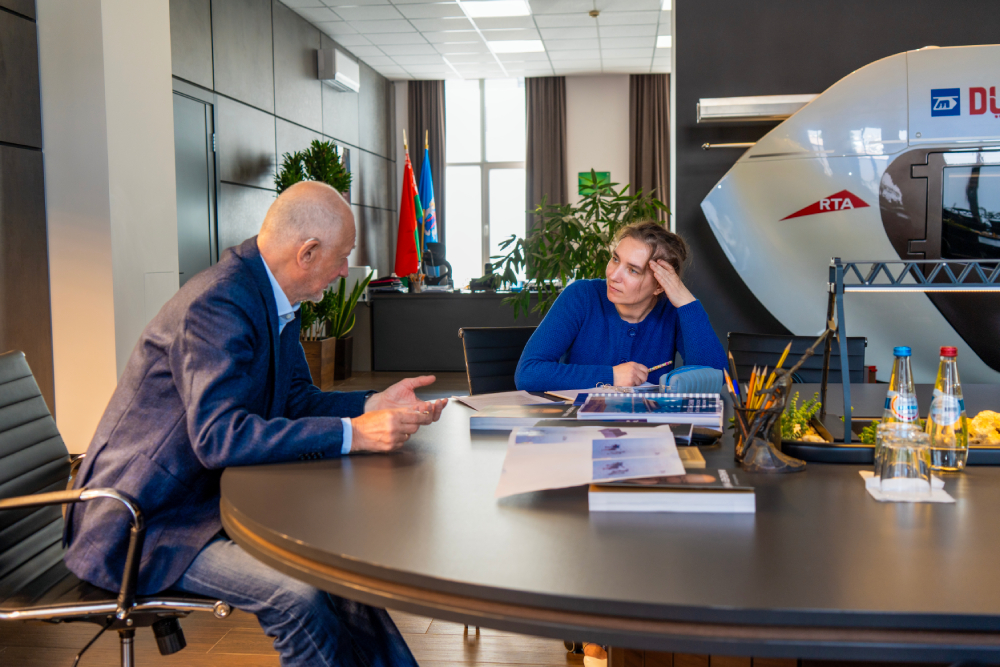
In an interview with the newspaper Transportnaya Bezopasnost (Transport Security), the Chief Designer of UST Inc. discussed the development of the uST technology and its commercial projects.
The newspaper Transportnaya Bezopasnost (Transport Security) is a specialized industry publication issued with the support of the Ministry of Transport and Communications of the Republic of Belarus and the State Traffic Inspectorate.
In a conversation with the newspaper's special correspondent, Anatoli Unitsky spoke about the implementation of the company's second commercial project in the country, the prospects for deploying string technologies, and their role in the transport system of the future.
“Our goal is not to eliminate all other modes of transport. Our task is to supplement and gradually replace them where it is effective to do so.” Anatoli Unitsky emphasized in the interview.
The full interview is available below.
UNITSKY’S AERIAL ROADS
Belarus has a chance to become the birthplace of the eighth wonder of the world
Every year, road accidents around the world kill the equivalent of the entire population of Minsk Region — about 1.5 million people. Meanwhile, 20 million are injured, maimed, or disabled. The inevitability and irreversibility of premature deaths have become the reality in countries where transport and roads exist.
THE WHO IS NOT GETTING ANYWHERE
The official WHO website states that from 2010 to 2021, efforts to reduce road deaths fell short of their targets: a 5% improvement between the two dates is clearly not enough on a global scale.
The outlook for the new decade's goal — set for the period 2021 to 2030 — to cut fatalities in half does not inspire much optimism based on past experience: as of 2019, road accidents had become the leading cause of death among people aged 5 to 29. The WHO is sounding the alarm and urging countries to focus primarily on preventive measures.
All these Sisyphean efforts look like an attempt to break through a wall head-first, when one could simply change direction and walk through the open doorway that was there all along — designed by the architect, calculated by the engineer, and built by the builder. In Belarus, that door has been held open for more than 50 years by Anatoli Unitsky, the inventor and chief designer of string transport technologies.
DIVIDE AND FLY
The flaw in the many attempts to minimize road deaths and injuries is that they focus on solving a global problem within the confines of the existing transport system. Anatoli Unitsky proposes shifting public attention toward a fundamentally new approach to movement in space — one where the transport's trajectory is completely separated from all other technical and biological trajectories.
It might seem that all the optimal spatial niches for traffic are already taken, but there is still vacant space between sky and ground — space well suited to solving a problem of global scale, if the vehicle, the uPod (an unmanned car on steel wheels), is simply suspended below or mounted atop an elevated open-frame overpass, with its trajectory clearly defined by a second-level string rail.
The absence of accidents at speeds of up to 500–600 km/h for intercity routes and up to 150 km/h for city and suburban travel is not science fiction. And most importantly, people would stop dying, because pedestrians would remain on the ground — the first level — while other vehicles occupy their own designated cells of space. At the same time, the human factor and the risk of technical malfunction are eliminated through both digital systems — a fully automated control system — and mechanical safety systems, such as the uPod's anti-derailment system, which keeps it on the string rail even in abnormal situations. 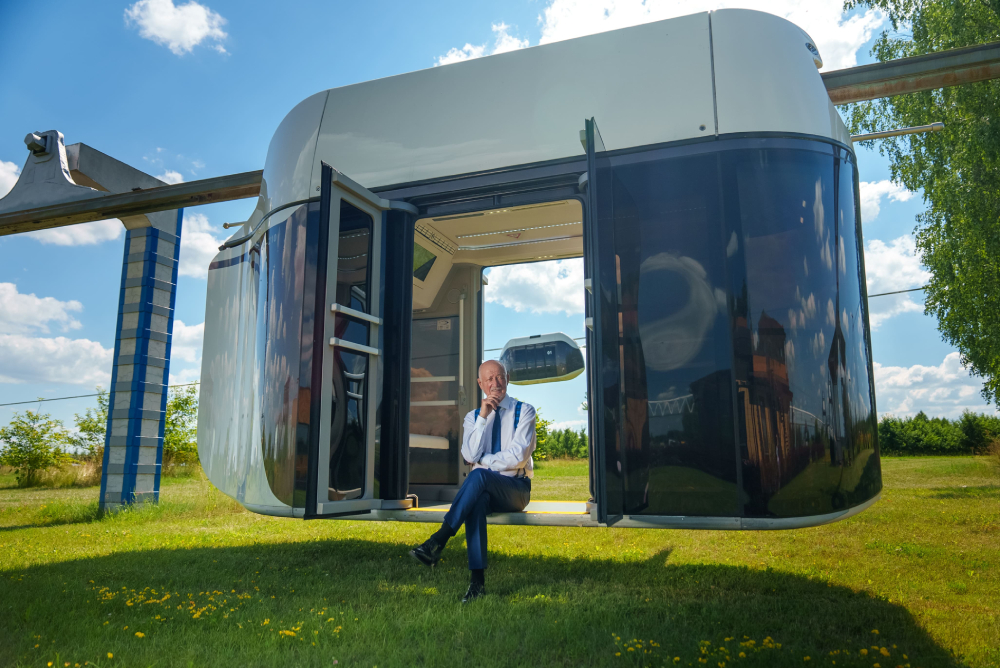
The inventor of string transport in a 14-seat uPod
UNDER THE AEGIS OF THE "TOURISM" STATE PROGRAM
A correspondent from "Transport Safety" (TB) went to see the chief designer of string technologies, Anatoli Unitsky, to find out firsthand how close the hour is when uPods will become an everyday mode of transport for Belarusians.
— Have the seven test tracks of string transport built in Belarus and the United Arab Emirates lived up to your expectations? What were their main objectives?
— We had several tasks at once. First, we needed to test various types of track structures — monorail, bi-rail, quad-rail, mounted and suspended, flexible, semi-flexible, rigid and semi-rigid. Each has its own area of application, depending on terrain, travel speed, type of cargo, the presence of wide obstacles to be crossed in a single span, and other transport and logistics tasks facing any industry-forming technology — which is exactly what string technologies are.
Second, we needed to test various models of rolling stock. To date, 15 models of uPods have been developed, manufactured, and tested — rail vehicles for both passengers and cargo, mounted and suspended, with capacities ranging from 2 to 48 passengers and load capacities of up to 30 tons.
Third, we needed to confirm the stated technical characteristics of the system — safety, reliability, energy efficiency, automated control, and design speeds of up to 150 km/h.
Fourth, we needed to obtain the necessary evidence base for certification and further commercial deployment of the technology.
As a result, we have built seven transport and infrastructure complexes with spans ranging from 40 to 400 meters, totaling more than 7 km, along with around 50 buildings and structures, more than 100 supports — both anchoring structures and supporting towers — and a complete engineering infrastructure.
The technology has stopped being a concept and become a working system that people can see with their own eyes and test. Test and demonstration tracks are currently operating in Belarus, in Maryina Gorka, and in the UAE, in Sharjah. Potential customers can come, personally ride a uPod, and evaluate the complex's performance under real conditions. This is precisely what allowed us to move from the testing phase to the commercial rollout phase. Today, the first commercial facility — the uLite transport system in Belarus — is already carrying passengers. A second commercial facility is under construction — at the "Sosny" sanatorium.
— Which type of string transport is planned for the "Sosny" sanatorium: uPod, uBus, uCar, or uFlash?
— "uPod" is the general name for all models of string transport rolling stock, regardless of their capacity, purpose, or design. It is the same way the word "automobile" is used for a car, a truck, or a minivan alike.
As for the "Sosny" sanatorium, a specific passenger uPod model will be used there — designated U5-54220. It is a suspended bi-rail passenger electric vehicle designed to carry visitors along a route connecting the residential building and the spa complex. The cabin seats six people, including one space for a passenger with limited mobility. All materials are fire-resistant. The exterior surfaces are covered with aluminum honeycomb panels, which simultaneously increase structural rigidity and reduce heat loss.
The climate control system of the U5-54220 model has been thought through down to the smallest detail, so nothing will disturb the comfort of the sanatorium's visitors.
The project is being carried out under the aegis of the state "Tourism" program and will be part of a large-scale renovation of the medical facility's infrastructure ahead of its 50th anniversary. This is the first state commercial string transport initiative in Belarus since the uLite project in Maryina Gorka.
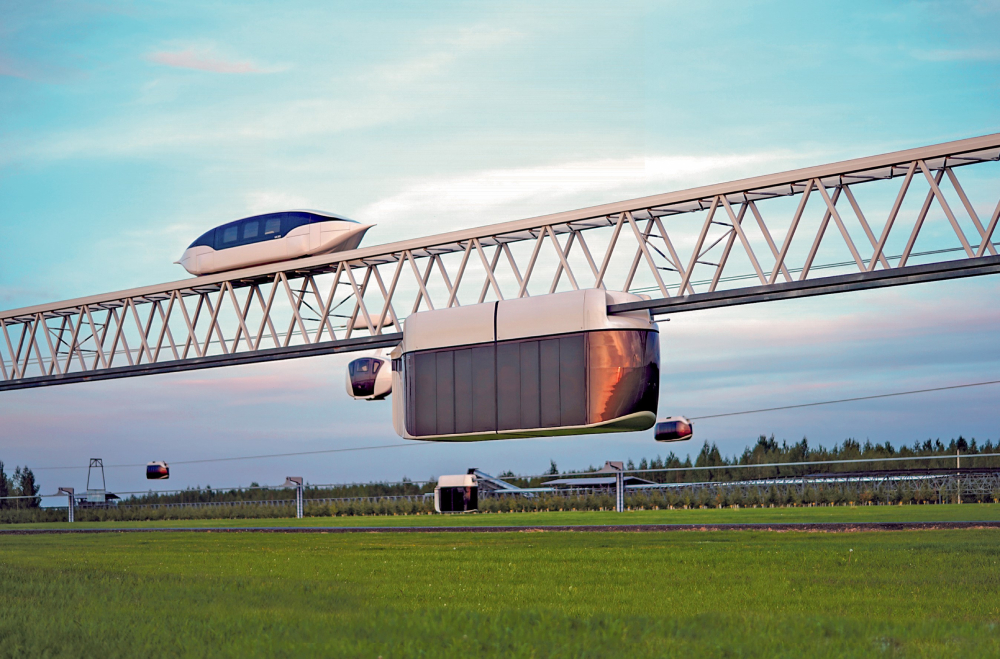
uPods during a test run in the EcoTechnoPark
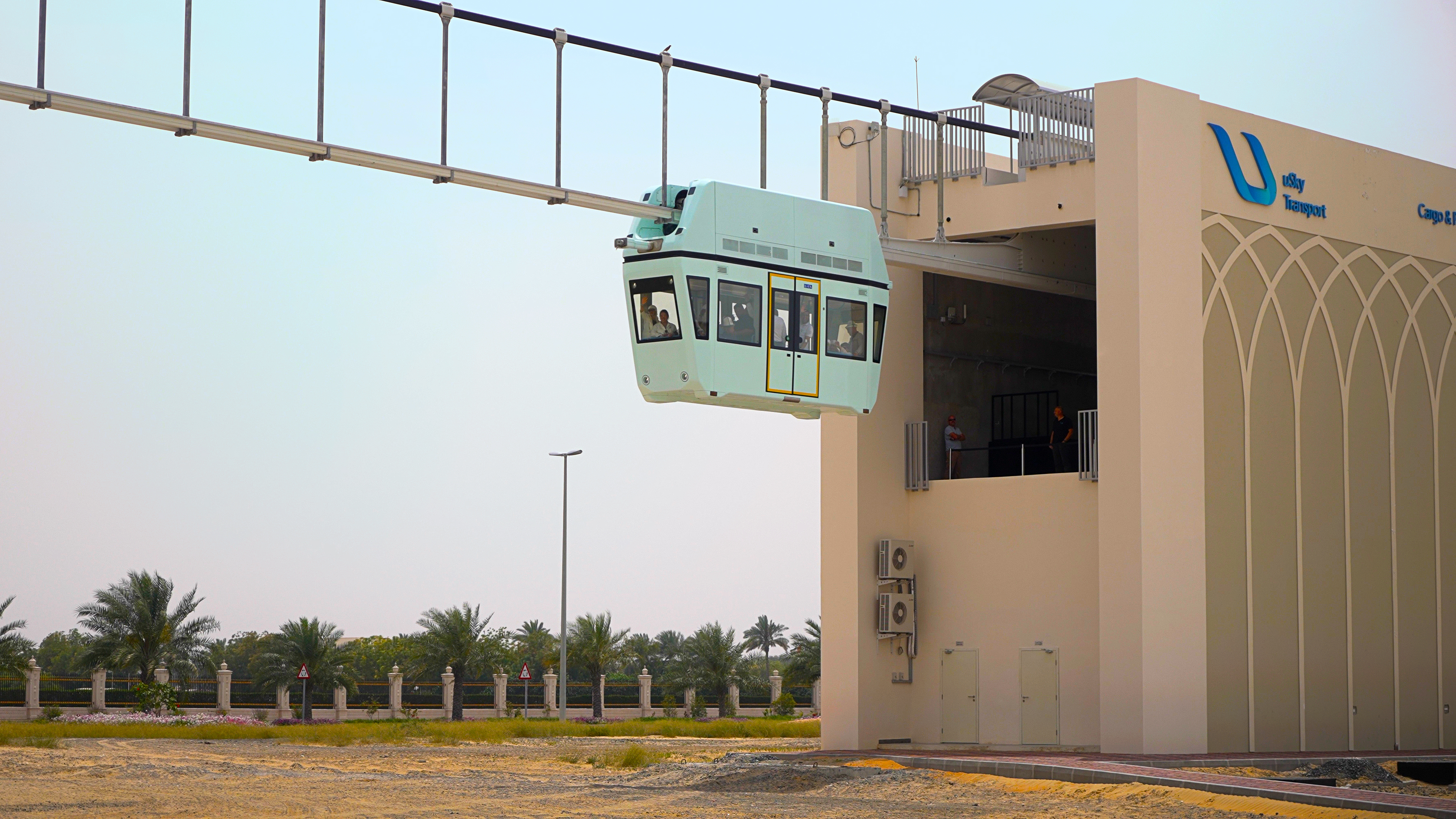
The Karat uPod with passengers inside, on a string rail track in Sharjah, UAE
PLANNING AHEAD
— Any movement is inseparably tied to roads. If all other modes of transport were excluded, leaving only string transport, how would passengers and cargo be distributed outside the uPods' coverage zone?
— Our goal is not to eliminate all other modes of transport. Our task is to supplement and gradually replace them where it is effective to do so.
How will the system work? In cities, string transport becomes a "second level" above the existing streets, taking the load off ground transport. On main routes, it will connect cities and regions, handling the bulk of passenger and cargo flow. In hard-to-reach areas — mountains, over water, on permafrost, in the desert — where building ordinary roads is not economically viable.
— Will the concept of personal transport fade into history in this new, environmentally clean world of string technologies?
— Not entirely, but its role will change dramatically. What will remain? Bicycles, electric scooters, walking — for getting around within a neighborhood or to a string transport station. The personal car as we know it today will not disappear completely, but it will stop being the primary means of daily travel. And over time, a personal uPod will appear — more efficient, safer, and less expensive — but only once a network of string roads has been put into operation.
What will go away? The mass use of personal cars for commuting to work and back, for shopping trips, for getting around the city. Because it is inefficient, unecological, and takes up enormous amounts of space. On average, a car sits in a garage, a parking lot, or a traffic jam 95% of the time, carries one or two people, and takes up dozens of square meters of urban space in the process. It is an absurdity we have simply grown used to treating as normal.
Svetlana YAROSHEVICH, TB